
The Cheapest B2B Courier Aggregators for Small Businesses in India (2026)
27 August 2026 · 11 min read · by Courier Uncle team
If you run a small B2B business in India — say you supply to shops, distributors or other businesses in bulk — you already know shipping doesn’t work the same way it does for a normal online store. Weight slabs are bigger. Freight is calculated differently. And if you pick the wrong courier, one bad shipment can eat up your entire profit on that order.
So most small business owners end up doing the same thing: they open Google at some point and type “cheapest B2B courier aggregator for small business India” and hope something useful shows up.
This article is meant to actually answer that. Below is a straight comparison of the aggregators small B2B sellers in India commonly use, what they cost, what to watch out for, and how to pick one without getting locked into a bad contract.

Why B2B shipping costs get out of hand for small businesses
Most small business owners don’t lose money on shipping because rates are bad everywhere. They lose money because of a few very specific, very common mistakes:
- Sticking with one courier because switching feels like a hassle, even when that courier is not the cheapest for most of their routes
- Wrong rate type — not knowing that B2B (bulk/wholesale) shipments are priced differently from single-parcel D2C shipments, and paying D2C-style rates for bulk loads
- Hidden COD charges they didn’t fully understand when they signed up
- No RTO visibility — return-to-origin numbers that quietly add cost every month
- Manual comparisons — checking 3–4 courier websites for every big order, which takes time most owners don’t have
- Untracked surcharges — fuel surcharges, handling fees or “minimum billable weight” clauses that quietly inflate the final invoice
This is exactly the gap a courier aggregator is supposed to fill — instead of managing five courier relationships separately, you get one dashboard that shows you the cheapest option for each shipment automatically.
But not every aggregator is actually cheap. Some look cheap on the landing page and then add COD fees, minimum monthly charges, or fuel surcharges that show up only in the fine print. So let’s actually compare.
The hidden costs most small businesses don’t budget for
Before the comparison, it helps to understand what’s actually inside a typical courier bill, because “rate per kg” is rarely the whole story:
- Fuel surcharge — usually 8–15% on top of the base freight, and it changes every quarter
- Minimum billable weight — some couriers round every shipment up to a minimum slab (e.g., anything under 5 kg gets billed as 5 kg)
- Docket or handling charge — a small flat fee per shipment, which adds up fast if you ship daily
- Appointment/ODA charges — out-of-delivery-area charges for certain pincodes, especially rural or hill areas
- GST — always confirm whether the rate quoted to you is inclusive or exclusive of GST
None of these are dealbreakers on their own. The problem is when three or four of them stack up on every shipment without you noticing, and your “cheap” courier turns out to be the expensive one by the end of the month.
Cheapest B2B courier aggregators in India — a real comparison
These numbers are approximate and change often, so treat this as a starting point, not a final quote. Always confirm current rates directly with the aggregator for your specific weight slab and route before signing up.
| Aggregator | Starting Rate* | Courier Network | COD Charges | Good For |
|---|---|---|---|---|
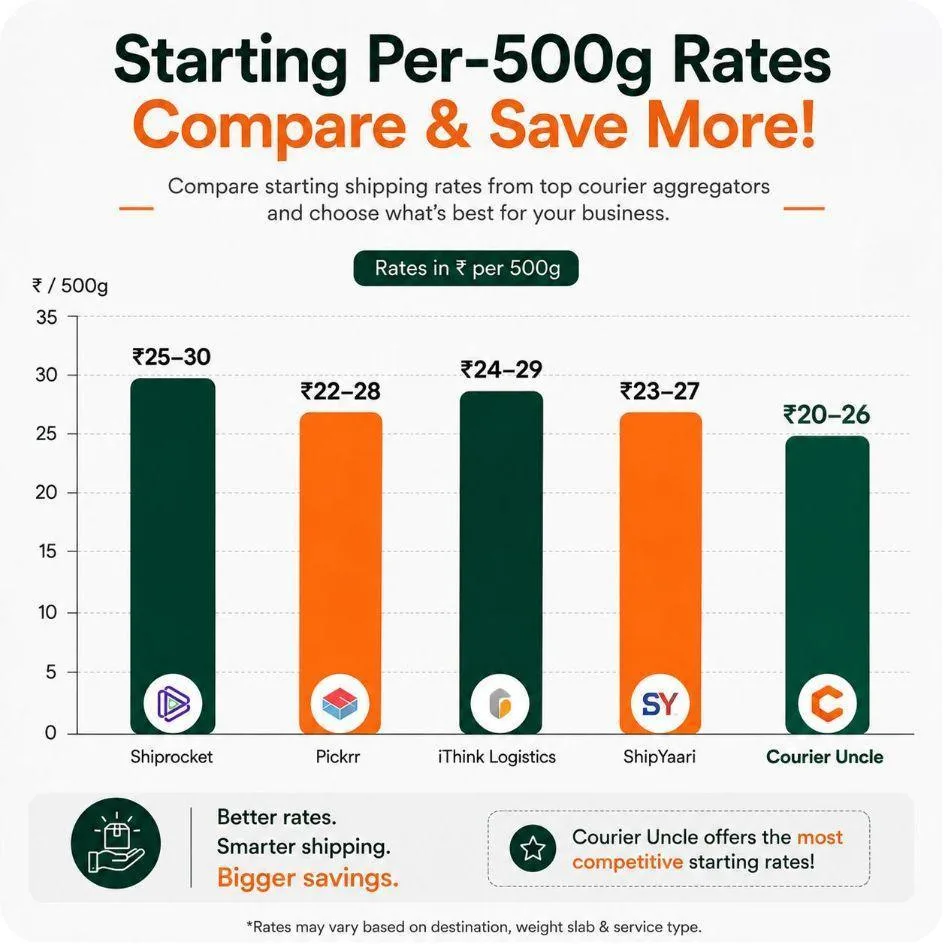
| Shiprocket | ₹25–30/500g | 17+ couriers | 1.5–2% + fixed fee | High-volume D2C brands |
| Pickrr | ₹22–28/500g | 15+ couriers | 1.2–2% | Growing online sellers |
| iThink Logistics | ₹24–29/500g | 20+ couriers | 1.5–2.5% | Bulk B2B + B2C mix |
| ShipYaari | ₹23–27/500g | 12+ couriers | 1.5–2% | Small D2C sellers |
| Courier Uncle | ₹20–26/500g | Multiple couriers + own fleet | Low, clear remittance schedule | Small & new B2B/B2C sellers who want low starting cost |
Starting rate is for a 500g parcel within the same zone/region. B2B bulk shipments are usually priced per kg above 5–10 kg slabs and get cheaper per kg as volume goes up — always ask for a bulk rate card separately.
What this table doesn’t tell you (and why you should still call each one)
Rate cards on paper rarely tell the full story, especially for B2B. Two things worth checking directly with each aggregator before you decide:
- Bulk/wholesale slab pricing — most published rates are for single small parcels, not for 10–50 kg B2B loads, which are priced on a completely different card
- Zone-wise variation — an aggregator that’s cheapest for Delhi-to-Mumbai might not be the cheapest for Delhi-to-Guwahati; ask for pricing on your actual top 3–5 routes, not a generic quote
This is also where the “aggregator” model genuinely pays off — instead of you calling four companies and comparing manually every time, the platform does this per shipment, automatically, and picks whichever partner is cheapest for that specific route and weight on that day.
A quick example: how this plays out for a real small business
Take a small hardware supplier in Ludhiana who ships bulk orders — 10 to 40 kg boxes — to retailers across Punjab, Haryana and Delhi NCR twice a week.
For the first few months, they used a single courier because that’s who their neighbouring shop recommended. Average cost worked out to around ₹42 per kg on interstate bulk shipments, and RTO on a few far-off pincodes was close to 18% because failed deliveries weren’t followed up quickly.
After switching to an aggregator model — comparing rates for each shipment instead of using one default courier, and turning on automatic re-attempt for failed deliveries — the average cost dropped to about ₹31 per kg, and RTO came down to under 8% within two months.
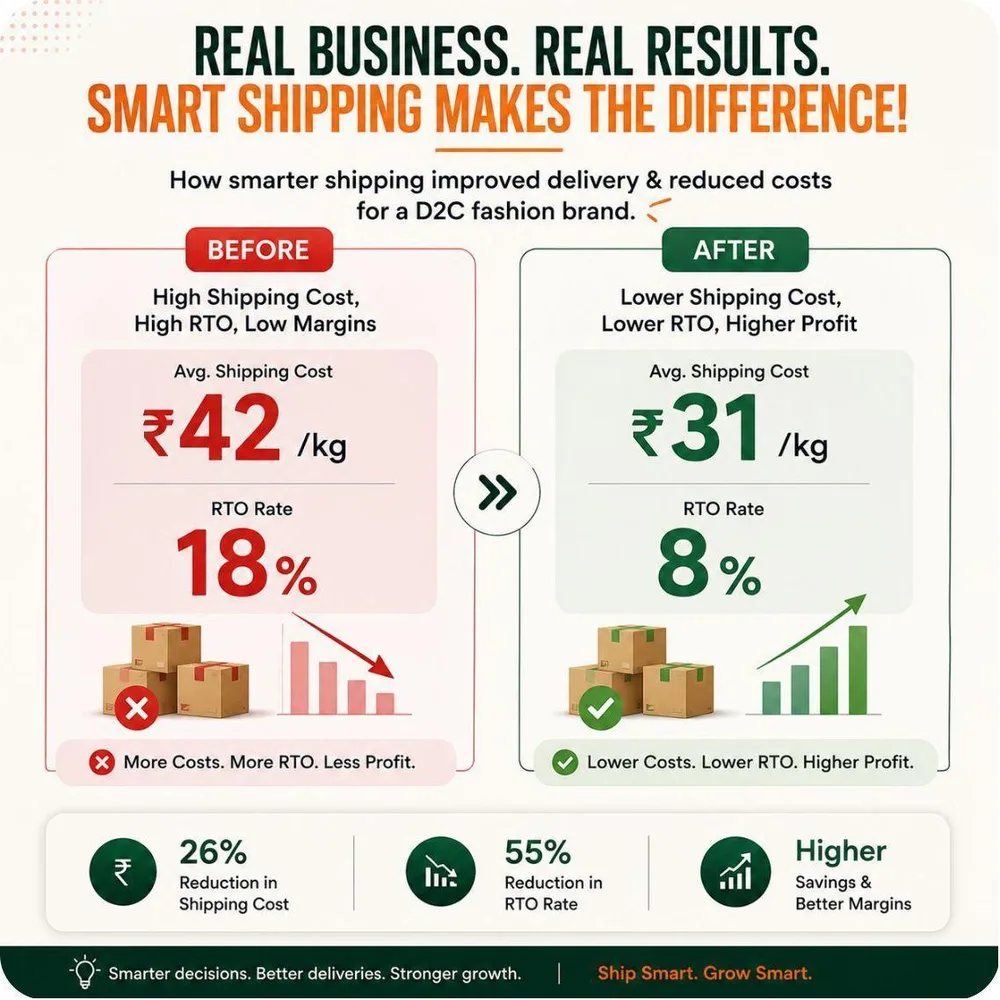
Nothing changed about their product or their customers. The only thing that changed was how shipping was booked and tracked.
A second example — this time on cash flow, not just cost
A small textile wholesaler in Surat ships COD orders to smaller retailers in tier 2 and tier 3 towns across Gujarat and Madhya Pradesh. Their biggest complaint wasn’t the shipping rate at all — it was that COD remittance from their old courier took 12 to 15 days to hit their account.
With order volume growing every month, that gap meant they were constantly short on cash to buy new stock, and were relying on short-term credit from suppliers just to keep up. After moving to an aggregator with a fixed 7-day COD remittance cycle, that gap closed. Nothing about their sales changed — just how fast their own money came back to them.
The point here is simple: when you’re comparing “cheapest,” don’t look at freight rate alone. For a lot of small B2B businesses, remittance speed affects the business more than a rupee or two difference in per-kg cost. (Deciding between COD and prepaid for your own orders? We’ve broken that down separately in our prepaid vs COD guide.)
How to actually pick the cheapest aggregator for your business
“Cheapest” on a website doesn’t always mean cheapest for your business. Here’s what to check before signing up with any aggregator:
- Ask for your actual rate card, not the homepage number. The number on the landing page is usually the best-case rate for light, short-distance parcels. Ask specifically for pricing on your typical weight and your typical routes before comparing anything.
- Check COD and cash handling charges separately. Some aggregators quote a low shipping rate but recover margin through COD or cash handling fees. If you collect cash on delivery for any part of your business, this number matters as much as the freight rate.
- Look at RTO and NDR handling, not just price. A cheap courier with a high RTO rate can cost you more overall than a slightly pricier one with better delivery success. Ask how NDR (failed delivery) cases are handled — automatically, or only if you follow up manually.
- Confirm there’s no minimum monthly commitment. Small businesses shouldn’t have to commit to a fixed monthly shipment volume to get decent rates. If an aggregator insists on a minimum before giving you their best pricing, that’s worth factoring into your decision.
- Check how fast you actually get paid (for COD). A slow COD remittance cycle ties up your working capital, even if the shipping rate itself looks cheap. Ask for the exact remittance schedule in writing.
- Ask what happens on pincodes your usual courier doesn’t cover well. Every courier has weak zones — certain pincodes where they’re slow, or don’t deliver reliably at all. A good aggregator either routes those orders to a different partner automatically, or has its own last-mile fleet to fall back on. Ask specifically about your worst-performing pincodes, not just your best ones.
- Read the support setup before you need it. At some point you will have a shipment go missing, a wrong weight dispute, or a delayed COD payment. What matters is whether you get a real person to talk to, or a ticket number and a long wait. Ask how support works — chat, phone, WhatsApp — before you sign up, not after something goes wrong.
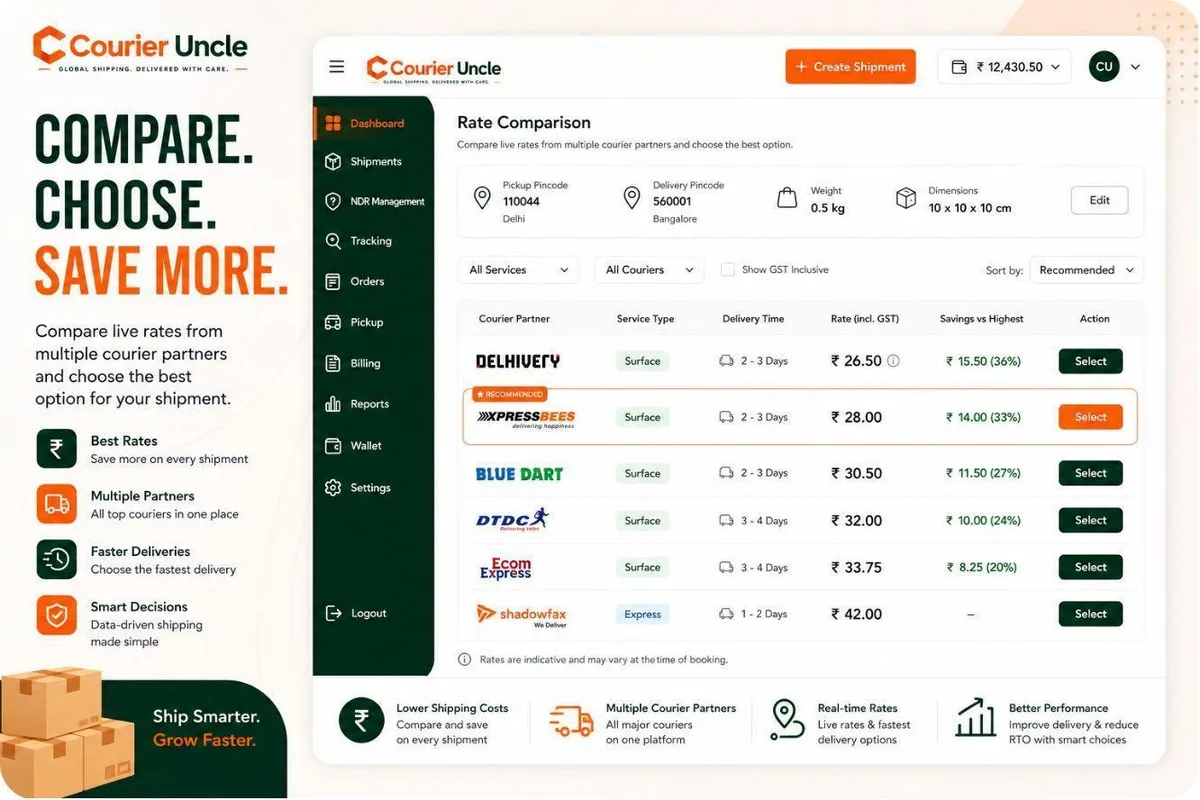
This is where an aggregator like Courier Uncle tends to work well for small B2B sellers specifically — rates are pooled across multiple sellers from day one (so you don’t need high volume to get a decent price), there’s no forced minimum commitment, COD remittance runs on a fixed schedule, NDR/RTO follow-up is automated instead of something you have to chase manually, and there’s an in-house last-mile fleet to fall back on for pincodes where partner couriers struggle.
What you’ll need before your first bulk shipment
If you’re moving from a single courier to an aggregator, it helps to have this ready in advance so onboarding doesn’t slow you down:
- GSTIN and business PAN details for invoicing
- Current address and pickup location(s) — some aggregators support multiple pickup points
- Average parcel weight and dimensions for your most common product/box sizes
- A rough monthly shipment volume estimate, even if it’s approximate
- Your top 5–10 delivery routes/pincodes, so you can ask for accurate rate quotes on the lanes you actually use
- Bank account details for COD remittance
Having this ready usually cuts onboarding down to under a day, and lets you get an accurate — not generic — rate quote from the start. (Still weighing an aggregator against a single courier? That trade-off has its own guide.)
Frequently asked questions
Is a courier aggregator actually cheaper than booking directly with a courier?
Usually yes, for small and mid-size businesses. Individual couriers give their best rates to high-volume customers. An aggregator pools shipments from many sellers, so you often get better pricing than you’d negotiate on your own, without needing high volume.
What’s the difference between a B2B and B2C courier aggregator?
B2C aggregators are built around single-parcel deliveries to individual customers. B2B (or bulk) shipping involves heavier loads, different weight slabs, and often different documentation (like e-way bills for higher-value shipments). Not every aggregator handles both well — check specifically for bulk/B2B support.
Do I need a minimum number of shipments to get good rates?
Not with most modern aggregators. Some legacy providers still require a minimum monthly volume for their best rates, but many newer platforms — including Courier Uncle — offer pooled pricing from your very first shipment.
How much can RTO actually cost a small business?
On COD-heavy categories, RTO can run anywhere from 10% to 25% for sellers who don’t actively manage it. Each RTO usually means paying for both forward and return freight, plus losing the sale. Automated NDR handling is one of the highest-impact ways to bring this down.
Can I switch aggregators if I’m not happy with the rates?
Yes, in most cases — check the specific terms before signing up, but most aggregators don’t lock you into long contracts. It’s worth reviewing your rates every few months regardless of who you’re with.
Is GST charged separately on courier rates?
Yes, courier services attract GST, and it’s usually charged on top of the freight rate. Always ask whether a quoted rate is inclusive or exclusive of GST before comparing two aggregators, otherwise you’re not comparing like for like.
What documents do I need for B2B shipments above a certain value?
For high-value B2B consignments, you may need an e-way bill in addition to a regular invoice, depending on the value and distance involved. Most aggregators will tell you during booking if one is required — but it helps to keep your GST invoice details ready regardless.
Ready to compare real rates on your own routes? Sign up free on Courier Uncle — pooled pricing from your first shipment, no minimum commitment.
Ship smarter with Courier Uncle
Compare live rates across multiple couriers on your actual routes — sign-up is free, no volume commitment.
Compare rates free →